

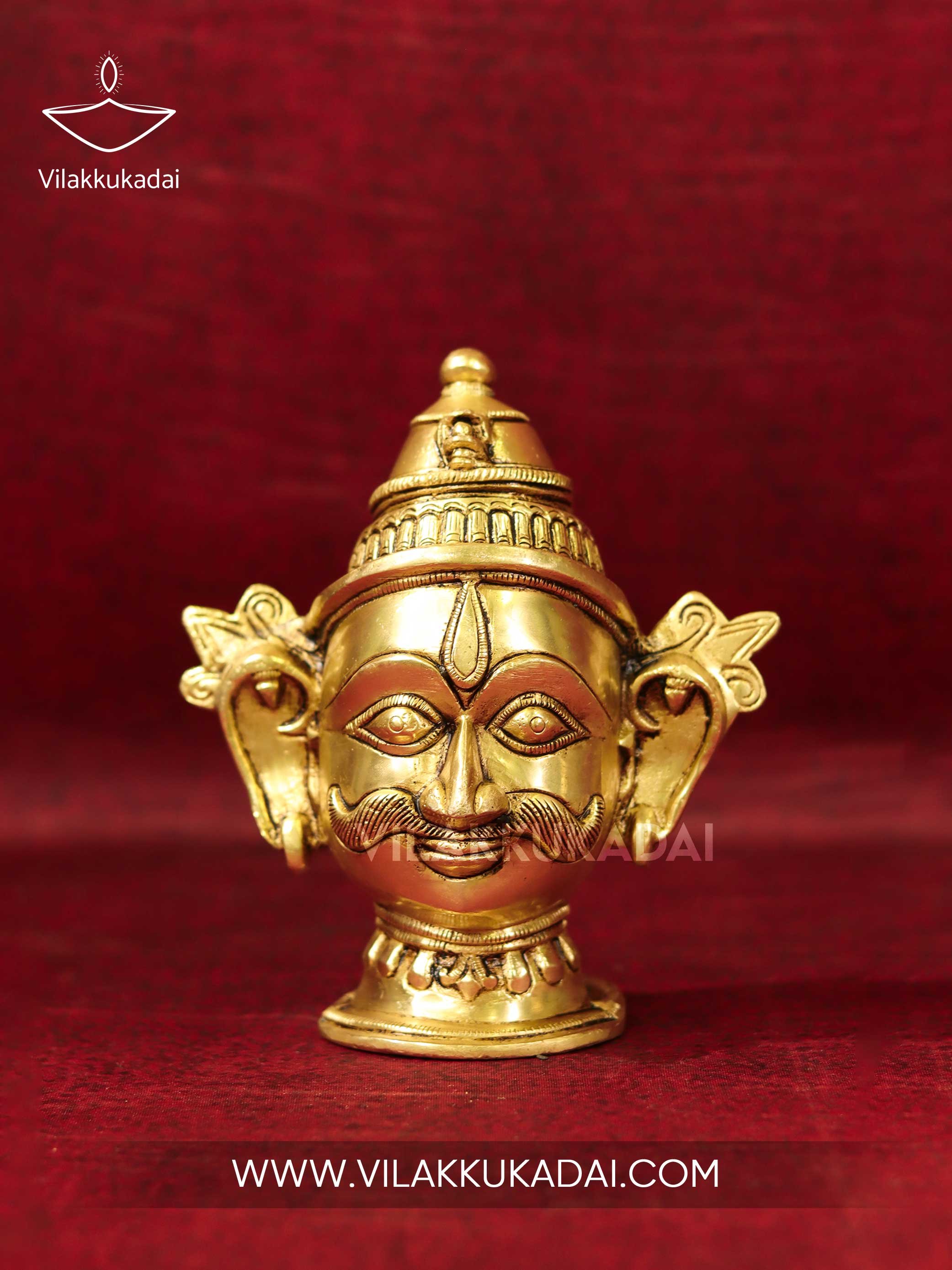
This hand-crafted piece may have slight irregularities and imperfections which only add to the unique charm of the product.
This product As crafted from copper that is considered to be a sacred metal and traditionally used in prayer accessories.
Shivan Parvathi Face
₹5,100 ₹5,870
Price Summary
- ₹5,870
- ₹5,100
- 13%
- ₹5,100
- Overall you save ₹770 (13%) on this product
SHIPPING INFO:
Dispatched in a maximum of 7-10 business days. This item is not eligible for return. Cancellation requests will be accepted strictly within 24 hours of placing the order only. This product is made on order.
We also ship worldwide. International shipping charges are calculated at checkout.
| Weight | 1.850 kg |
|---|---|
| Dimensions | 3 × 6 × 7 in |
You May Also Like
Rajarajeshwari Devi with Thiruvachi/ 8″/ Lalithambikai/ Brass Idol/ Lalitha Tripura Sundari
The rajarajeshwari statue made by Brass with tiruvachi.
- Typically show the goddess seated on a lotus, often in a lalitasana pose, and adorned with jewels and a saree.
- She is frequently depicted with four arms, each holding symbols of creation, sustenance, and destruction,
- such as a goad (ankusha),
- a noose (pasha),
- a sugarcane bow (ikshukhanda),
- five flowered arrows.(poo charam)
Annapoorani Statue/ 5.5″/ Annapurna Devi/ Annapoorneshwari Idol/ Brass Anna Lakshmi
Annapoorani statue is crafted from a brass material ,often holding a ladle and bowl, symbolizing her role as a provider of sustenance.
Tulja Bhavani Amman/ 4.5″/ Tulja Bhavani Murti/ Brass Idol/ Tuljapur Mata
The Chottanikkara Devi Temple is a temple dedicated to the Hindu mother goddess Bhagavati, also seen as a form of Mahalakshmi.She is believed to be residing in Chottanikkara along with her husband Maha Vishnu.
Chottanikkara Devi is worshipped at the temple, in three different forms: as Mahasaraswati in the morning, draped in white; Mahalakshmi in noon, draped in crimson; and as Mahaparvati in the evening, decked in blue.
Tulja Bhavani Amman/ 5.5″/ Tulja Bhavani Murti/ Brass Idol/ Tuljapur Mata
The Chottanikkara Devi Temple is a temple dedicated to the Hindu mother goddess Bhagavati, also seen as a form of Mahalakshmi.She is believed to be residing in Chottanikkara along with her husband Maha Vishnu.
Chottanikkara Devi is worshipped at the temple, in three different forms: as Mahasaraswati in the morning, draped in white; Mahalakshmi in noon, draped in crimson; and as Mahaparvati in the evening, decked in blue.
Karumari Amman/ 5.5″/ Mariamman Statue/ Angalamman/ Brass Idol/ Pooja Decor
Mariamman, often abbreviated to Amman, is a Hindu goddess of rain.
She is considered as a guardian deity (kaval deivam).
The word Mari has the Sangam Tamil origin meaning “Rain”, and the Dravidian root term Amman means “Mother”. She was worshipped by the ancient Tamils as the bringer of rain and thus also the bringer of prosperity, since the abundance of their crops was dependent largely upon adequate rainfall.
Mariamman has since been associated with Hindu goddesses like Parvati, Kali, Durga, Rukmini, Sita, Draupadi.
Annapoorani Statue/ 3.5″/ Brass Annapurna Devi/ Annapoorneshwari/ Anna Lakshmi
ANNAPOORANI
- “Annapoorani” refers to “Goddess of Food“ or “Goddess of Nourishment”.Â
- Annapoorani is a name for a form of the Hindu goddess Durga, specifically representing abundance and prosperity through food and sustenance.Â
- The name is derived from the Sanskrit words “Anna” (meaning “food” or “grains”) and “PÅ«rṇa” (meaning “full, complete, and perfect”).Â
Saraswathi 27″
- Saraswati is the embodiment of knowledge, wisdom, and learning. She is also the patron deity of the arts, music, and all creative endeavors.
- Saraswati is seen as the goddess of speech, eloquence, and the ability to express oneself clearly.
- The name Saraswati is derived from the Sanskrit words “saras” (meaning “flowing stream” or “river”) and “wati” (meaning “she who possesses”). This suggests she is the one who possesses or controls the flow of knowledge and wisdom.
- Saraswati is considered the consort of Brahma, the creator god in Hinduism, and is often depicted with him.
- She is typically depicted holding a book, a veena (a stringed musical instrument), and a rosary, representing knowledge, music, and devotion.
- She is also known by other names, such as Sharada, Savitri, Vani, and Vagdevi, all of which relate to her role as the goddess of knowledge, wisdom, and speech.Â
Annapoorani 6.5″
ANNAPOORANI
- “Annapoorani” refers to “Goddess of Food“ or “Goddess of Nourishment”.Â
- Annapoorani is a name for a form of the Hindu goddess Durga, specifically representing abundance and prosperity through food and sustenance.Â
- The name is derived from the Sanskrit words “Anna” (meaning “food” or “grains”) and “PÅ«rṇa” (meaning “full, complete, and perfect”).Â
Andal/ 6″/ Goda Devi/ Brass Idol/ Andal Thayar/ Divine Idol
- Andal is a prominent figure in the Sri Vaishnava tradition, known for her devotion to Lord Vishnu and her poetic works. She is believed to be an incarnation of Goddess Lakshmi, the goddess of wealth and fortune, and the wife of Lord Vishnu.Â
- Andal is one of the 12 Alvar saints, revered for their devotional poetry and contributions to Sri Vaishnavism.
- She is credited with writing the “Thiruppavai” and “Nachiar Thirumozhi,” which are revered devotional works in the Tamil language. Her poetry, particularly the “Nachiar Thirumozhi,” reveals her deep yearning for Vishnu, expressed through vivid imagery and poetic language.
- She is worshipped in her birthplace, the Srivilliputhur Andal Temple, which is one of the 108 Divya Desams (temples visited by the Alvars).Â
Nava Durgai set
Durga is a major Hindu goddess, worshipped as a principal aspect of the mother goddess Mahadevi.
She is associated with protection, strength, motherhood, destruction, and wars.
Durga is believed to unleash her divine wrath against the wicked for the liberation of the oppressed, and entails destruction to empower creation.
Durga is seen as a motherly figure and often depicted as a beautiful woman, riding a lion or tiger, with many arms each carrying a weapon and often defeating demons.
Kaali With Thiruvachi/ 6″/ Kali Statue/ Brass Idol/ Pooja Decor
KAALIÂ
- The Divine Mother,The black one,
- Kali is the Hindu goddess of death and rebirth
- She expresses the dual nature of the destruction that must come before new beginnings, and of the strength of the female power which can sometimes do what the man cannot.
- She is also the goddess of time.Â
Mariamman Statue/ 3″/ Angalamman/ Brass Idol/ Karumariamman Statue/ Mari Amman
Mariamman, often abbreviated to Amman, is a Hindu goddess of rain.
She is considered as a guardian deity (kaval deivam).
The word Mari has the Sangam Tamil origin meaning “Rain”, and the Dravidian root term Amman means “Mother”. She was worshipped by the ancient Tamils as the bringer of rain and thus also the bringer of prosperity, since the abundance of their crops was dependent largely upon adequate rainfall.
Mariamman has since been associated with Hindu goddesses like Parvati, Kali, Durga, Rukmini, Sita, Draupadi.
Recently Viewed
Vengala Bowl No.2/ 3″/ Brass Cup/ Pooja Bowl/ Pooja Accessory
Vengala BowlÂ
Plain Jula Big/ 9″/ Brass Jhula/ Jhoola/ Oonchal/ Oonjal
Jula
Yali Statue/ 9″/ Yazhi Idol/ Brass Statue
- Meaning and Symbolism: Idols often hold deep cultural, spiritual, or religious significance, representing concepts such as positivity, wealth, harmony, protection, or specific virtues. For example, a Ganesha idol symbolizes the remover of obstacles, while a meditating Buddha statue invites peace and calmness.
- Materials: They are crafted from a wide range of materials, each offering different aesthetics and durability:
- Metals: Brass and bronze are popular for their longevity, intricate craftsmanship, and association with luxury, often developing a rich patina over time.
- Stone: Marble, granite, and sandstone can add a timeless, grand aesthetic to a space.
- Resin/Polyresin: These modern, versatile materials allow for detailed designs and are often more lightweight and affordable, suitable for mass production and travel-friendly options.
- Wood: Handcrafted wood idols offer an earthy look and a natural scent, ideal for a traditional feel.
- Ceramic/Polyresin: Used for contemporary and abstract pieces, often with matte or glossy finishes.
- Design & Craftsmanship: Idols can be simple or feature intricate detailing, often handcrafted by skilled artisans using traditional techniques. Designs can be traditional (e.g., specific postures of deities according to ancient texts) or modern (e.g., abstract thinker statues or astronaut figurines).
- Usage: While some are designed specifically for a home temple or place of worship, many are used as versatile decorative showpieces for living rooms, bedrooms, offices, or gardens. They also serve as popular items for gifting on occasions like weddings, housewarmings, and birthdays.Â
Krishna Murti/ 14″/ Gopal Murti/ Brass Krishnar/ Kanha Ji/ Divine Idol
 KRISHNA WITH FLUTE
- God Krishna with a flute symbolizes divine music, spiritual devotion, and the enchanting qualities of Krishna.
- It represents a connection to spirituality, love for music, and a desire for inner peace.
- The flute is also a powerful symbol of love and devotion, capturing the essence of divine music that resonates with the hear, Krishna’s flute is often associated with the divine sound of the universe, representing the vibrations of spiritual awakening
MATTUVANDI
- Meaning and Symbolism: Idols often hold deep cultural, spiritual, or religious significance, representing concepts such as positivity, wealth, harmony, protection, or specific virtues. For example, a Ganesha idol symbolizes the remover of obstacles, while a meditating Buddha statue invites peace and calmness.
- Materials: They are crafted from a wide range of materials, each offering different aesthetics and durability:
- Metals: Brass and bronze are popular for their longevity, intricate craftsmanship, and association with luxury, often developing a rich patina over time.
- Stone: Marble, granite, and sandstone can add a timeless, grand aesthetic to a space.
- Resin/Polyresin: These modern, versatile materials allow for detailed designs and are often more lightweight and affordable, suitable for mass production and travel-friendly options.
- Wood: Handcrafted wood idols offer an earthy look and a natural scent, ideal for a traditional feel.
- Ceramic/Polyresin: Used for contemporary and abstract pieces, often with matte or glossy finishes.
- Design & Craftsmanship: Idols can be simple or feature intricate detailing, often handcrafted by skilled artisans using traditional techniques. Designs can be traditional (e.g., specific postures of deities according to ancient texts) or modern (e.g., abstract thinker statues or astronaut figurines).
- Usage: While some are designed specifically for a home temple or place of worship, many are used as versatile decorative showpieces for living rooms, bedrooms, offices, or gardens. They also serve as popular items for gifting on occasions like weddings, housewarmings, and birthdays.Â
Shiva Lingam Nandhi Set/ 4.5″/ Panchalogam Shiv Ling Nandi/ Panchaloha Shivling Statue
Nandi also known as Nandikeshwara or Nandideva, is the bull vahana of the Hindu god Shiva. He is also the guardian deity of Kailash, the abode of Shiva.
Nandi has the meaning of happy, joy, and satisfaction, the properties of divine guardian of Shiva- Nandi.
A lingam, sometimes referred to as linga or Shiva linga, is an abstract or aniconic representation of the Hindu god Shiva in Shaivism. It is typically the primary murti or devotional image in Hindu temples dedicated to Shiva, also found in smaller shrines, or as self-manifested natural objects.
Lingam is regarded as the “outward symbol” of the “formless Reality”, the symbolization of merging of the ‘primordial matter’ with the ‘pure consciousness in transcendental context.


